

Wireless Site Survey Palm Desert — Ekahau Predictive, Onsite, and Validated Across the Coachella Valley
A Palm Desert site survey from WiFi Hotshots — delivered fixed-fee with Ekahau AI Pro and ECSE-certified engineers — is the same engagement as a Palm Desert wireless site survey, with the wireless scope made explicit in the SOW. Ekahau ECSE certified engineers deliver every Palm Desert wireless site survey as a fixed-fee SOW — two-hour dispatch from our Valencia HQ to the Coachella Valley resort, medical, and event-venue corridors.
WiFi Hotshots is a vendor-agnostic enterprise network engineering firm serving Palm Desert and Coachella Valley customers, resort operators, medical groups, and network engineering teams across Riverside County and the broader US market.
Ekahau ECSE — Certified Survey Engineer on every engagement
Multi-CCIE engineering bench
Fixed-fee SOW — no T&M surprises
25 years of enterprise networking leadership
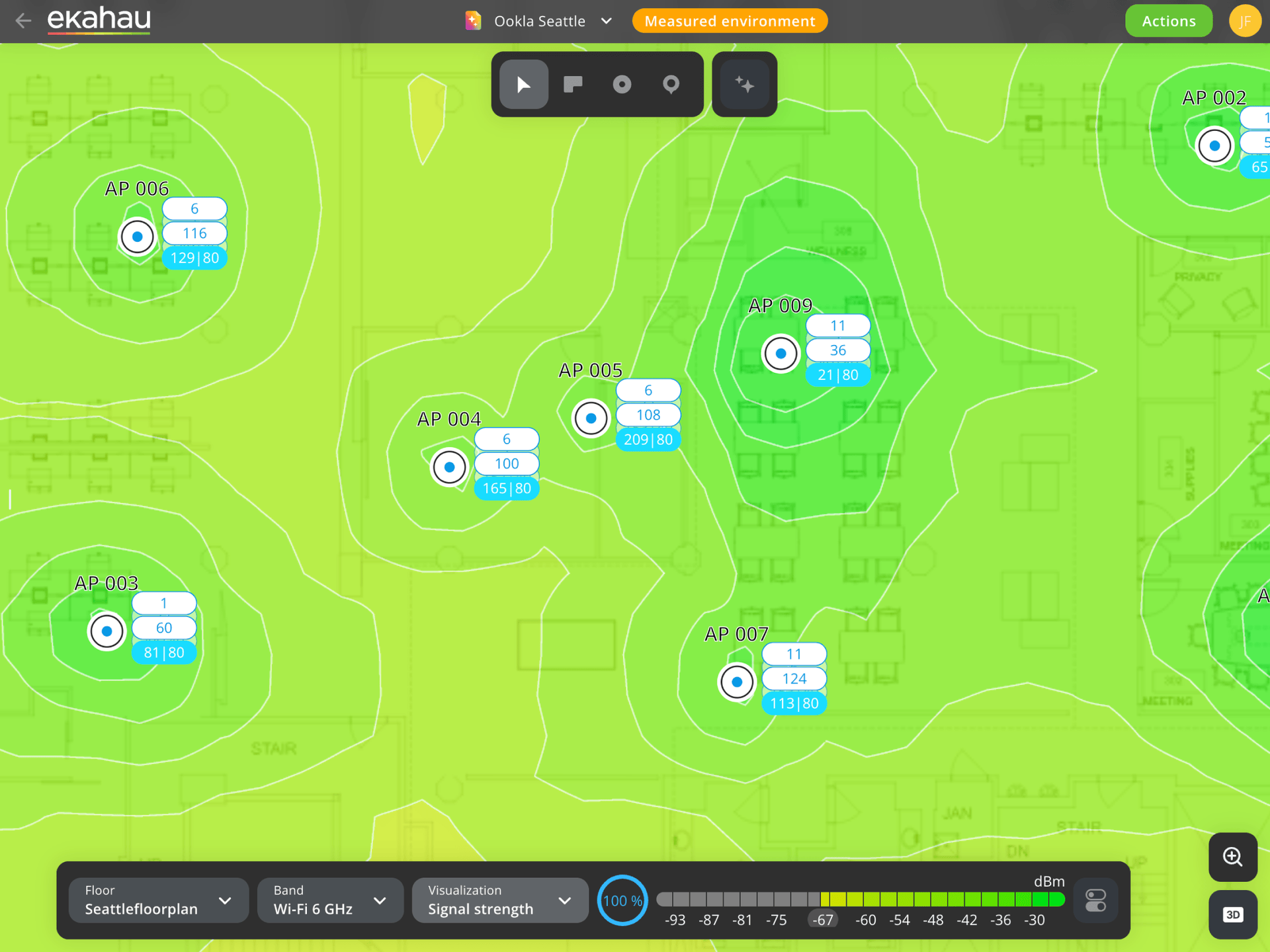
A Palm Desert wireless site survey from WiFi Hotshots starts with Ekahau predictive modeling and closes with post-install validation heatmaps — every engagement a fixed-fee SOW, not hourly billing.
We cover the full Coachella Valley from our Valencia HQ on a two-hour drive to Palm Desert: JW Marriott Desert Springs and Omni Rancho Las Palmas resort footprints, Eisenhower Health and Desert Regional Medical Center clinical floors, Kaiser Permanente Palm Desert Medical Offices outpatient footprints, UCR School of Medicine Palm Desert Campus academic floors, Empire Polo Club event-season RF planning for Coachella and Stagecoach, Indian Wells Tennis Garden stadium bowls hosting the BNP Paribas Open, College of the Desert and CSUSB Palm Desert Campus lecture halls, Desert Sands USD and Palm Springs USD CMU-block classroom buildings, and open-terrain outdoor AP engineering across Mission Hills, Ironwood, and The Reserve country-club properties.
Every Palm Desert wireless site survey engagement includes the full Coachella Valley geography — Palm Springs, Rancho Mirage, La Quinta, Indio, Cathedral City, Desert Hot Springs, and Indian Wells — under the same fixed-fee SOW structure. See the enterprise wireless services overview, the full enterprise network services portfolio, our engineering credentials and certifications, or send us your floor plans to start a scope call.
Why Palm Desert Wireless Survey Projects Fail Without an RF Baseline
Coachella Valley building stock is not generic. Resort properties along the El Paseo corridor and across Rancho Mirage, Indian Wells, and La Quinta carry Mid-Century-era stucco-over-metal-lath exterior walls, terra-cotta roof tile, and in-slab copper plumbing that modern predictive RF models tuned to drywall-and-stud office stock underestimate by a meaningful margin. Casita and villa clusters at properties like JW Marriott Desert Springs (884 rooms and 101 suites plus 450,000-plus sq ft of meeting space per Marriott) and the Omni Rancho Las Palmas (444 rooms and suites) use detached or semi-detached construction where floor-to-floor signal penetration fights terra-cotta tile and double-stucco assemblies.
Eisenhower Health’s 106-acre Rancho Mirage campus (463 licensed beds per HCAI) and Desert Regional Medical Center in Palm Springs (385 licensed beds, the only Level 1 trauma center in the Coachella Valley) carry lead-lined imaging suites and clinical corridors built across multiple additions spanning decades of construction practice.
Empire Polo Club’s 1,000-acre Indio grounds transition from open turf to concession footprints to backstage production villages over a festival week; Indian Wells Tennis Garden Stadium 1 (16,100 seats, second-largest outdoor tennis stadium in the world) has an upper-bowl roof treatment that creates an enclosed airtime environment fighting roof reflection. Deploying APs without a measured RF baseline means your channel plan is built on assumptions, not data. When a Spectralink handset drops on an Eisenhower patient floor or a Zebra scanner misses a concession stand at the far end of the polo fields, the root cause is always the same: the pre-deployment work was skipped or compressed.
A Palm Desert wireless site survey is not optional for complex environments — it is the engineering step that separates a network that works from one that generates tickets.
The design target for a general enterprise data environment is a minimum ‑67 dBm RSSI at cell edge with at least 25 dB SNR. For clinical voice-grade networks at Eisenhower, Desert Regional, JFK Memorial Hospital, and the outpatient footprint at Kaiser Permanente Palm Desert — Spectralink Versity, Vocera Smartbadge, Ascom handsets — the threshold tightens to ‑65 dBm primary coverage and ‑63 dBm for RTLS location services, with 15–20% cell overlap to support 802.11r fast BSS transition and sub-50 ms re-association. None of those thresholds can be confirmed by looking at a floor plan. They require measurement.
Ekahau Predictive Survey Methodology: Floor Plan Ingestion to AP Placement Map
Every WFHS engagement begins in Ekahau AI Pro, the design and analysis module within the Ekahau Connect platform. The workflow starts with floor plan import at measured scale — either CAD-exported PDF or a photographed as-built drawing re-scaled to a known distance. Wall types are assigned material attenuation values: glass, drywall, CMU, poured concrete, concrete with rebar, terra-cotta tile, and stucco-over-metal-lath each carry different dB-per-meter loss figures. For Coachella Valley Mid-Century resort construction with stucco-over-metal-lath, the metal-lath layer is modeled separately from modern drywall because the lath changes the 5 GHz and 6 GHz attenuation profile materially.
Terra-cotta roof tile on casita and villa clusters at Ritz-Carlton Rancho Mirage, JW Marriott Desert Springs, and La Quinta Resort is treated as a distinct roof assembly rather than a generic tile value, because floor-to-floor signal paths fight the baked-clay mass differently than asphalt or membrane roofs. Once the floor plan is calibrated, the AI Auto-Planner runs AP placement simulations against the design requirement profile — coverage at ‑67 dBm RSSI, channel plan, and secondary-AP overlap for 802.11k neighbor list population. The output is an AP count per floor with placement coordinates and a draft bill of materials.
For Palm Desert deployments, predictive design typically covers 1,200–2,000 sq ft per AP on 5 GHz and 6 GHz radios in open-plan office environments. High-density spaces require tighter placement intervals driven by client count and MOS score targets rather than coverage radius alone: JW Marriott Desert Springs meeting and ballroom zones at roughly 1 AP per 1,000 sq ft with 20 MHz channels per Cisco high-density guidance, Eisenhower ICU and telemetry floors at roughly 1 AP per 1,200 sq ft for biomed coexistence, and Empire Polo Club stage-adjacent zones at 1 AP per 25–35 concurrent clients under peak festival load.
Predictive survey is accurate for standard construction. On atypical Coachella Valley assemblies — stucco-over-metal-lath, terra-cotta tile, in-slab copper, refurbished Mid-Century additions, and lead-lined clinical imaging suites at Eisenhower and Desert Regional — the predictive model flags uncertainty zones that require an AP-on-a-Stick validation pass before hardware procurement.
- AP count per floor with X/Y placement coordinates exportable to AutoCAD or PDF overlay
- Channel plan: 2.4 GHz channels 1/6/11 for coverage; 5 GHz 20/40/80 MHz assignments per zone; 6 GHz LPI channel selection for Wi-Fi 6E and Wi-Fi 7 APs indoors (indoor LPI class, no AFC required per FCC Part 15 Subpart E); 6 GHz UNII-5/UNII-7 standard-power outdoor requires AFC coordination at up to 36 dBm EIRP
- Per-band heatmap exports showing RSSI, SNR, secondary coverage (802.11k), and co-channel interference overlay
AP-on-a-Stick Validation for Coachella Valley Venues: Hospitality, Medical, and Event Venues
AP-on-a-Stick (APoS) methodology mounts a production-model AP on a telescopic pole at the intended deployment height — typically 12–18 ft for ceiling-tile environments inside resorts and clinical corridors, 25–40 ft for event-mast temporary coverage at Empire Polo and Indian Wells Tennis Garden, and 1.2 m (golf-cart seat height) for outdoor surveys across open terrain at country clubs and polo fields. The Ekahau Sidekick 2 attaches to the survey laptop via USB-C and runs four tri-band radios scanning 2.4, 5, and 6 GHz simultaneously at up to 50 sweeps per second across the full 2.400–2.495 MHz and 5.000–7.125 MHz ranges with 19 kHz frequency resolution per the Ekahau datasheet.
The Sidekick 2’s active cooling system maintains operating temperature in Coachella Valley summer surveys where a passively cooled tool would thermally throttle; the surveyor walks the floor while the tri-band radios record passive RF measurements at every point — RSSI, SNR, noise floor (target below ‑92 dBm per Cisco VoWLAN 4.1 guidance), and co-channel interference — across every visible AP. That measurement data overwrites the predictive model where they differ, producing a hybrid design that combines simulation efficiency with field accuracy.
Coachella Valley venues that mandate APoS rather than predictive-only include any facility where drawings do not reflect reality. Resort engagements at the archetype scale of JW Marriott Desert Springs (884 rooms, 450,000-plus sq ft of meeting space), the Grand Hyatt Indian Wells Resort & Villas (531 rooms post-2024 rebrand, including 39 suites and 43 villas), the Ritz-Carlton Rancho Mirage (244 guest rooms including 16 suites), and the Westin Mission Hills Resort Villas require room-by-room passive validation — hallway-only soffit plans fail at guestroom edge against stucco-over-metal-lath wall budgets.
Clinical floors at Eisenhower Health, Desert Regional Medical Center, and JFK Memorial Hospital carry infection-control constraints on above-ceiling access that require cable routing to be confirmed before the first AP is mounted; lead-lined imaging suites boundary as RF-opaque zones on the heatmap.
Tribal casino floors at Agua Caliente Resort Casino Spa Rancho Mirage, Morongo Casino Resort & Spa in Cabazon, Fantasy Springs Resort Casino in Indio, Spotlight 29 Casino in Coachella, Augustine Casino in Coachella, and Cabazon Casino require gaming-control-board audit language in the SOW — California Gambling Control Commission and tribal-state compact oversight mean every Palm Desert wireless site survey across a gaming floor ships with surveillance-system airtime coexistence documentation, slot-management wireless isolation notes, and a separate network-segmentation attestation for tribal gaming regulator review.
College of the Desert’s 160-acre Palm Desert main campus (plus the Indio, Palm Springs, and Mecca/Thermal satellites), the 166-acre CSUSB Palm Desert Campus on Cook Street, and the UCR School of Medicine Palm Desert Campus require seat-by-seat density confirmation in classrooms and lecture halls.
Event venues — Empire Polo Club hosting Coachella and Stagecoach at a daily cap of up to 125,000 attendees across 1,000 acres with peak periods exceeding 200,000 concurrent clients across cellular and Wi-Fi, and Indian Wells Tennis Garden’s Stadium 1 (16,100 seats) and Stadium 2 (8,000 seats) hosting the BNP Paribas Open each March — require sectorized directional antenna planning because client density, not signal density, is the limiting factor. These institutions are referenced as venue archetypes, not as claimed engagements.
- Hospitality: stagger AP placement inside guestrooms and across casita clusters; plan for 3-plus devices per guest per Cisco Meraki Hospitality Design Guide; maximum three SSIDs per radio (guest, staff, IoT) to protect airtime; outdoor pool-deck and cabana coverage on shaded outdoor APs with indoor-AP-plus-directional-antenna supplementation through conditioned service corridors
- Healthcare: infection-control ceiling-plenum constraints confirmed before cable pathways are routed; lead-lined imaging suite boundaries flagged as RF-opaque zones requiring AP relocation; VoWLAN handset roaming exercised on Spectralink, Vocera, and Ascom form factors; 2.4 GHz airtime hygiene (three non-overlapping channels, 20 MHz width) because legacy biomed telemetry still depends on the band
- Event and stadium: sectorized directional antennas for main stages and bowl seating; omnis only at back-of-house and vendor rows; 20 MHz channel width mandatory under high-density load; airtime target below 40% per BSS at peak; 6 GHz UNII-5/UNII-7 AFC standard power at up to 36 dBm EIRP opens new reuse patterns polo fields and stadium bowls did not have in 2019
- Tribal gaming: surveillance-system coexistence language in the SOW; slot-management wireless isolation; separate network-segmentation attestation documented for California Gambling Control Commission and tribal-state compact review; gaming-floor RF measurement conducted under casino-operations-approved staging windows
Floor plans and device counts are all we need to scope the work — most Palm Desert engagements are quoted on a fixed-fee SOW within three business days of a 30–60 minute scoping call.
Passive and Active Validation: Throughput, Roaming, and Voice MOS Testing
A passive survey records every RF signal in the environment without associating to any SSID. The Ekahau Sidekick 2 listens — it measures what the air contains, not what a connected session reports. Passive surveys are used for pre-deployment environment assessment (neighbor AP inventory, noise floor, DFS radar event detection) and for post-install coverage confirmation. DFS event rates across the Coachella Valley are not generic.
Palm Springs International Airport (PSP) ground-based ATC radar, the PSP Terminal Doppler Weather Radar (TDWR) installation in the 5600–5650 MHz band, and Thermal-Jacqueline Cochran Regional radar coverage are DFS-proximate to portions of the east valley; UNII-2A and UNII-2C channels see measurably higher radar-event rates near these sites than in generic metro locations, and any Palm Desert wireless site survey inside the TDWR-proximate footprint captures DFS-exposure data band-by-band before production DFS channel assignments are enabled.
Coachella and Stagecoach festival weekends produce seasonal LTE and cellular spikes across licensed bands that raise the ambient RF floor at Empire Polo and the Indio Fairgrounds; Santa Ana wind events through the San Gorgonio and Banning Pass corridors produce blown-dust interference that affects millimeter-wave backhaul more than sub-7 GHz Wi-Fi but is measured during the same passive walk. Validate DFS exposure and seasonal ambient-RF shifts with field measurement before enabling DFS channels in production. The output is a heatmap for every band, every floor, at every survey waypoint — color-coded RSSI, SNR, and secondary coverage for 802.11k neighbor list validation.
Active validation associates to the production SSID and measures what the client actually experiences. iPerf3 bidirectional throughput runs confirm uplink and downlink capacity against the designed channel width. Roaming tests exercise 802.11r fast BSS transition — the protocol is designed to shorten roaming interruptions, and 50 ms or less is the accepted voice-grade handoff target that 802.11r was built to support.
Active testing with a roaming test client confirms whether the deployed controller configuration actually achieves it or whether a misconfigured minimum RSSI threshold is stalling the handoff. For voice-over-Wi-Fi migration engagements — Cisco Webex Calling, CUCM, or Teams Phone — the active test also captures a MOS (Mean Opinion Score) trace across the full walking route.
A voice-grade network targeting MOS 4.0+ requires the ‑67 dBm RSSI and 25 dB SNR thresholds to hold at cell edge without exception; for clinical handsets roaming across Eisenhower, Desert Regional, JFK Memorial, and Kaiser Permanente Palm Desert patient floors the threshold tightens to ‑65 dBm primary and 802.11r + 802.11k + 802.11v re-association under 50 ms. Any area that drops below those targets appears as a gap in the post-install validation report, with a remediation recommendation tied to a specific AP or configuration change. The independent post-install validation report is the deliverable your operations team, auditor, or next engineer can pick up without context.
Coachella Valley Market Constraints on a Palm Desert Wireless Site Survey: Extreme Desert Thermal, Outdoor Resort RF, and Seasonal Occupancy Swing
Desert Thermal Reality and AP-Model-Specific Tmax Selection
Palm Springs recorded an all-time high of 124 °F (50.6 °C) on July 5, 2024, confirmed by NWS San Diego; average July–August daily highs across the Coachella Valley floor run 108–115 °F, with the Thermal area (roughly 120 ft below mean sea level) tracking 2–4 °F hotter than Palm Springs. Solar loading on a roof-mounted or pole-mounted outdoor AP routinely adds 10–20 °F to the enclosure surface above ambient. AP selection is not a brand-preference decision here — it is a Tmax calculation against the manufacturer datasheet.
The Meraki MR86 outdoor AP is rated ‑40 °C to +55 °C per the current MR86 datasheet on documentation.meraki.com (Wi-Fi 6 only, no 6 GHz radio); placed unshaded on a Palm Desert parking-lot pole in August, the MR86 reaches its operating ceiling during hot-afternoon hours.
The Cisco Catalyst CW9163E (Wi-Fi 6E, IP67, tested to 100 mph sustained / 165 mph gust wind resistance per the Meraki datasheet) is rated ‑40 °C to +65 °C without solar derating and ‑40 °C to +55 °C with solar derating — shade it under an eave or pergola and the 65 °C envelope applies; mount it unshaded on hot tile and the 55 °C derating ceiling applies.
The Cisco Catalyst IW9167E industrial outdoor AP is rated ‑40 °C to +70 °C with solar load in still air and is the one AP in the Cisco lineup that credibly survives an unshaded Palm Desert polo-field or parking-lot summer afternoon. The HPE Aruba AP-577 outdoor is rated ‑40 °C to +65 °C. The Ruckus T750 is rated ‑40 °C to +65 °C at IP67. Indoor APs belong in conditioned space, full stop: the Cisco Catalyst CW9166I indoor is rated 0 °C to +50 °C and will thermally throttle or fail if installed in an unconditioned attic or soffit where desert interior ambient exceeds 65–70 °C in July.
Field mitigations we specify on Palm Desert scopes: shade the AP under eave, pergola, or soffit; specify light-colored reflective NEMA 4X outer housings on pole-mount enclosures; use passive vented housings with insect screens for convective flow; maintain 6–8 ft of mounting height above baking asphalt or tile roofs; and prefer IW9167E-class APs for unshaded polo, parking, or golf-cart-path exposures where shading is not an option.
Outdoor Resort RF, Country-Club Open Terrain, and Seasonal Occupancy Swing
Palm Desert, Rancho Mirage, and Indian Wells together host more than 100 golf courses. Outdoor AP RF planning for Mission Hills, Ironwood, The Reserve, and similar country-club properties uses georeferenced orthophoto aerial imagery as the survey baseplate (rather than an interior floor plan), survey walks at 1.2 m golf-cart seat height rather than 0.9 m human walking height, and 5 GHz plus 6 GHz UNII-5/UNII-7 outdoor AFC for greenfield with 2.4 GHz reserved as legacy-IoT backup only.
The three non-RF outdoor deliverables we document on every country-club or pool-deck scope are lightning protection (N-type surge arrestors at AP and at MDF), cabling conduit sized for solar-loaded PoE derating per NEC 725.144 bundle-temperature rules (adopted under Title 24 Part 3 as the California NEC 2023 edition), and AP enclosure selection that accounts for solar-radiant heat gain.
Pool decks, patios, and cabanas are the cleanest mitigation case for an indoor AP plus external directional antenna through a wall penetration into an adjacent conditioned service corridor — the radio and electronics sit in conditioned space while the antenna radiates into the outdoor zone.
Seasonal occupancy on Coachella Valley resort properties swings dramatically: January through April brings roughly 300,000 seasonal residents and peak resort occupancy; June through September drops to summer lows where heat discourages outdoor use. Capacity planning has to support both states; the airtime discipline that supports 2,500 guests on a JW Marriott ballroom weekend in February must also work at the June occupancy floor without hidden airtime waste from unused high-capacity AP radios.
Event-Season Festival RF, Wind Corridors, and Public-Safety DAS Overlay
Coachella Valley event RF is shaped by three factors unique to the region. First, festival seasons (Coachella and Stagecoach at Empire Polo Club in Indio, with attendance peaks pushing aggregate concurrent client counts across cellular and Wi-Fi toward 200,000 across the festival grounds; the BNP Paribas Open at Indian Wells Tennis Garden each March) produce licensed-band cellular spikes that raise ambient RF floors temporarily and turn adjacent unlicensed bands into high-density environments for the duration.
Second, the Banning Pass and San Gorgonio Pass wind corridor routinely produces sustained 35–55 mph gusts through spring, with summer convective outflows producing 60–80 mph gusts from thunderstorm downdrafts; pole-mount hardware has to clear the 100 mph sustained / 165 mph gust envelope specified on the CW9163E datasheet for the brand you standardize on.
Third, ERRCS (Emergency Responder Radio Coverage Systems) applicability in Riverside County jurisdictions mirrors the LA County pattern: Acrisure Arena in Thousand Palms (75702 Varner Road, 11,000-plus seats, opened December 14, 2022), Eisenhower Health’s 106-acre Rancho Mirage campus, Desert Regional’s Palm Springs campus, Kaiser Permanente Palm Desert Medical Offices, and large resort and meeting-space buildings exceeding 50,000 sq ft or three stories above grade trigger NFPA 72 / NFPA 1221 public-safety radio coverage requirements; the BOMA ERRCS framework referenced in LA County is the same standards family applied by Riverside County AHJs.
On a WFHS Palm Desert wireless site survey, we identify existing ERRCS infrastructure in the ceiling plenum and route AP cable pathways to avoid conflict with BDA (bi-directional amplifier) donor-antenna and remote-unit cabling. WFHS is not an ERRCS integrator — if the survey reveals an ERRCS coverage gap or a BDA installation that does not satisfy the NFPA 1221 signal level requirements, the correct next step is a licensed ERRCS contractor, not a Wi-Fi vendor. We flag the gap, document the location, and coordinate referral. Our approach to clinical wireless environments covers both the survey methodology and the post-construction validation sequence for hospital and resort-campus ERRCS coordination.
Scope a Palm Desert Site Survey.
Send floor plans to sales@wifihotshots.com or call (844) 946-8746 — we return a fixed-fee SOW, not a multi-week proposal cycle.
Survey Deliverables: Heat Maps, BOM, Install Runbook, and Validation Report
At the close of every Palm Desert wireless site survey engagement, the client receives a complete document set — not a summary slide deck. The Ekahau project file (.esx) is included in every handoff so a future engineer can reopen the exact survey, adjust wall materials, or re-run the coverage model without starting from scratch. The platform mix — Cisco Catalyst 9800, Cisco Meraki MR, HPE Aruba Central (AOS-10), Juniper Mist, RUCKUS One, ExtremeCloud IQ — does not change the deliverable set. Every engagement ships with the same documentation regardless of vendor, because the documentation belongs to the client, not the vendor.
Guest and BYOD onboarding — NAC and zero trust policy or cloud-native captive portal, certificate-based authentication — is scoped as a separate design workstream when the survey reveals that the existing SSID architecture does not segment guest traffic (and resort scopes always do, because three SSIDs per radio is the Cisco Meraki Hospitality Design Guide ceiling). AP refresh and controller migration planning for Cisco Catalyst 9800 (IOS-XE 17.15+ for Wi-Fi 7), Meraki MR, HPE Aruba Central, Juniper Mist, RUCKUS One, and ExtremeCloud IQ is scoped separately where the survey identifies a controller version or capacity constraint.
- Ekahau project file (.esx) plus annotated heatmap exports per band (2.4, 5, 6 GHz) per floor: RSSI, SNR, secondary coverage (802.11k), and co-channel interference overlay
- Vendor-agnostic AP bill of materials with AP model, mount type, antenna selection, PoE class requirement, cabling length per drop, and AP-model-specific Tmax justification for outdoor placements (Meraki MR86 at 55 °C, Catalyst CW9163E at 65/55 °C, Catalyst IW9167E at 70 °C solar, Aruba AP-577 at 65 °C, Ruckus T750 at 65 °C)
- Installation runbook: AP placement drawing, cable pathway map, switch port assignment, VLAN/SSID configuration notes, and shading or enclosure specification for outdoor APs
- Post-install validation report: passive heatmap confirmation, iPerf3 throughput results, 802.11r roaming handoff timing, and MOS trace data for voice-grade engagements
- Design warranty: WFHS stands behind the AP count and placement — if coverage gaps appear at post-install validation that were not present in the design, we remediate the design at no additional cost
Palm Desert Wireless Site Survey Coverage and Service Map
WiFi Hotshots dispatches from Valencia to the full Coachella Valley on a two-hour drive to Palm Desert under the same fixed-fee SOW structure as our home-dispatch engagements. Coverage runs the full valley floor from Desert Hot Springs and Cathedral City through Palm Springs, Rancho Mirage, Palm Desert, Indian Wells, La Quinta, Indio, and Coachella, and up into the Morongo Basin for Yucca Valley (approximately 3,300 ft elevation), Joshua Tree, and Twentynine Palms (approximately 1,950 ft elevation) engagements where high-desert elevation and thermal profiles differ from the valley floor.
Event and venue scopes include Empire Polo Club’s 1,000-acre Indio festival grounds, Indian Wells Tennis Garden (Stadium 1 at 16,100 seats; Stadium 2 at 8,000 seats), Acrisure Arena in Thousand Palms (75702 Varner Road, 11,000-plus seats, opened December 14, 2022), and the Indio Fairgrounds. Hospitality scopes across the resort corridor include JW Marriott Desert Springs (884 rooms), Grand Hyatt Indian Wells Resort & Villas (531 rooms), Ritz-Carlton Rancho Mirage (244 rooms), Omni Rancho Las Palmas (444 rooms), the Westin Mission Hills Resort Villas, La Quinta Resort & Club, Parker Palm Springs, and multiple boutique Mid-Century-modern hotels across Palm Springs.
Tribal gaming scopes cover Agua Caliente Resort Casino Spa Rancho Mirage, Morongo Casino Resort & Spa in Cabazon, Fantasy Springs Resort Casino in Indio, Spotlight 29 Casino in Coachella, Augustine Casino in Coachella, and Cabazon Casino — each Palm Desert wireless site survey across a tribal gaming floor is scoped with California Gambling Control Commission and tribal-state compact audit language built into the SOW from day one. Clinical scopes cover Eisenhower Health’s 106-acre Rancho Mirage campus, Desert Regional Medical Center in Palm Springs, JFK Memorial Hospital in Indio, and Kaiser Permanente Palm Desert Medical Offices (outpatient, no inpatient beds).
Higher-ed and K-12 scopes cover College of the Desert’s 160-acre Palm Desert main campus plus Indio, Palm Springs, and Mecca/Thermal satellites, CSUSB Palm Desert Campus, the UCR School of Medicine Palm Desert Campus, and three K-12 districts covering roughly 66,000 combined students: Desert Sands USD (26,000 students across 34 schools), Palm Springs USD (23,000-plus students), and Coachella Valley USD (16,968 students across 22 schools).
Multi-site Coachella Valley engagements are coordinated from a single SOW and a single point of contact. For enterprise clients with facilities across multiple Southern California regions, we dispatch into adjacent service areas without a separate mobilization charge. The geo-family below shows the regional pages where market-specific survey details — LA metro density, San Fernando Valley media corridor, Inland Empire warehouse scale, coastal constraints — are documented for each sub-market.
Representative Palm Desert Wireless Site Survey Engagement Profiles — Coachella Valley Region
Resort-hospitality wireless refresh across guestroom and amenity footprints
The Coachella Valley resort archetype maps to an 800- to 900-room four-diamond resort property with 400,000-plus sq ft of meeting space, multiple pool decks, cabana zones, golf-course frontage, and a villa or casita cluster — the scale familiar to anyone who knows JW Marriott Desert Springs, Grand Hyatt Indian Wells Resort & Villas, or Omni Rancho Las Palmas.
Typical scope covers one AP per guestroom for premium tiers (required against stucco-over-metal-lath wall budgets), one AP per two adjacent rooms in corridor soffit for value tiers, 1 AP per roughly 1,000 sq ft at 20 MHz channels in meeting and ballroom zones per Cisco high-density guidance, 1 outdoor AP per roughly 3,000 sq ft at amenity seat count across pool decks and cabanas, and 3-plus-device-per-guest capacity sizing per Cisco Meraki Hospitality Design Guide.
Maximum three SSIDs per radio (guest, staff, IoT) is a requirement in the high-density configuration, not a guideline. Outdoor APs on pool decks and patios are specified against Tmax and solar derating: Catalyst IW9167E-class (70 °C solar) for unshaded placements and CW9163E-class (65 °C shaded / 55 °C derated) for eave-mounted placements. The deliverable set — per-floor heatmaps, vendor-agnostic AP BOM with Tmax-justified outdoor placements, installation runbook, and post-install validation report — is formatted for review by resort IT governance and the property management group. JW Marriott Desert Springs, Grand Hyatt Indian Wells, and Omni Rancho Las Palmas are referenced here as venue archetypes, not as claimed engagements.
Regional-hospital clinical-wireless network migration
The Coachella Valley regional-hospital archetype maps to a 150- to 500-licensed-bed acute-care facility with med-surg floors, ED bays, OR suites, ICU, and imaging — the scale familiar to anyone who knows Eisenhower Health (463 licensed beds on a 106-acre Rancho Mirage campus; Annenberg Pavilion adds 248 beds of capacity across 160 private and 88 surge), Desert Regional Medical Center (385 licensed beds, Level 1 trauma, Palm Springs), or JFK Memorial Hospital (145 licensed beds per HCAI, Indio).
Kaiser Permanente Palm Desert Medical Offices on the ambulatory side and the UCR School of Medicine Palm Desert Campus on the academic side each carry their own Palm Desert wireless site survey profile with outpatient-workflow and teaching-clinical-workflow design inputs respectively.
Typical scope covers a phased wireless migration with ‑65 dBm primary coverage at clinical depth and ‑63 dBm for RTLS location services (per AAMI TIR18 wireless medical device coexistence guidance), VoWLAN-grade roaming for Spectralink Versity, Vocera Smartbadge, and Ascom handsets with sub-50 ms 802.11r re-association, EHR bedside workflow coverage, 2.4 GHz airtime hygiene because legacy biomed telemetry still depends on the band, and ERRCS ceiling-plenum conflict identification across buildings meeting the 50,000 sq ft / three-story threshold.
WPA3-Enterprise or WPA2-Enterprise encryption with HIPAA-aligned network segmentation is a design input, not a compliance claim. The deliverable set is formatted for review by the health system’s IT governance committee. Eisenhower, Desert Regional, JFK Memorial, Kaiser Permanente Palm Desert, and UCR School of Medicine Palm Desert are referenced here as venue archetypes, not as claimed engagements.
Event and festival RF planning for 100,000-plus-attendee outdoor venues
The Coachella Valley event archetype maps to a 1,000-acre outdoor festival venue with daily attendance caps up to 125,000 and aggregate Wi-Fi-plus-cellular concurrent client totals approaching 200,000 during festival peaks — the scale familiar to anyone who knows Empire Polo Club hosting Coachella and Stagecoach (cap raised from 99,000 to 126,000 by Indio City Council in 2016), Indian Wells Tennis Garden hosting the BNP Paribas Open at 16,100 seats in Stadium 1 and 8,000 in Stadium 2, or Acrisure Arena in Thousand Palms at 11,000-plus seats.
Typical scope covers sectorized directional antennas for main stages and bowl seating (omnis only at back-of-house and vendor rows), 20 MHz channel width mandatory under peak festival or match load because airtime is the bottleneck not throughput, airtime target below 40% per BSS at peak, 1 AP per 25–35 concurrent clients, 6 GHz UNII-5/UNII-7 AFC standard power at up to 36 dBm EIRP for new outdoor reuse patterns, pole-mount and truss-mount hardware specified to the 100 mph sustained / 165 mph gust envelope against San Gorgonio Pass wind events, and temporary-coverage event-mast planning for production villages and concession footprints.
Dedicated DAS cellular offload for attendee LTE is a separate scope from Wi-Fi design. Empire Polo, Indian Wells Tennis Garden, and Acrisure Arena are referenced here as venue archetypes, not as claimed engagements.
Tribal gaming floor survey with state gaming regulator documentation
The Coachella Valley tribal gaming archetype maps to a resort-casino property with a 100,000-plus sq ft gaming floor, 1,000-plus slot and electronic-gaming positions, poker and table-game pits, surveillance-system RF coexistence requirements, and a 400- to 600-room adjacent hotel tower — the scale familiar to anyone who knows Agua Caliente Resort Casino Spa Rancho Mirage, Morongo Casino Resort & Spa in Cabazon, Fantasy Springs Resort Casino in Indio, Spotlight 29 Casino in Coachella, Augustine Casino in Coachella, or Cabazon Casino.
Every tribal-gaming Palm Desert wireless site survey ships with surveillance-system airtime coexistence documentation, slot-management wireless isolation attestation, and a network-segmentation statement formatted for California Gambling Control Commission and tribal-state compact review under the applicable gaming-control-board audit framework.
Typical scope covers gaming-floor RF density at 1 AP per 1,500–2,000 sq ft with 20 MHz channels, dedicated surveillance-network RF isolation (separate SSIDs, separate VLANs, hardware-segmented backhaul where the operator requires it), tower-side hospitality guestroom coverage on the resort-archetype pattern, and restaurant/convention-center meeting-space high-density zones at the Cisco high-density 1 AP per 1,000 sq ft guidance. Agua Caliente, Morongo, Fantasy Springs, Spotlight 29, Augustine, and Cabazon are referenced here as venue archetypes, not as claimed engagements.
Higher-ed desert campus wireless across main and satellite sites
The Coachella Valley higher-ed archetype maps to a community-college district with a 160-acre main campus and three to four satellite sites, plus a CSU upper-division and graduate campus on a separate 160-acre site, plus a UC medical-school campus — the scale familiar to anyone who knows College of the Desert (Palm Desert main campus plus Indio, Palm Springs, and Mecca/Thermal satellites, approximately 10,764 credit enrollment and roughly 14,000 unduplicated headcount), CSUSB Palm Desert Campus (166-acre Cook Street campus, upper-division plus graduate), and the UCR School of Medicine Palm Desert Campus.
Typical scope covers 1 AP per classroom as the durable pattern (hallway-only deployments fail under synchronized-class load), 1 AP per roughly 1,000 sq ft at HD in library and common-study zones, outdoor quad and event-lawn coverage surveyed separately per event profile and specified on IW9167E-class APs for unshaded placements, residence-hall roaming validation where applicable, and satellite-campus RF surveys that account for elevation, thermal, and construction-type differences between the Palm Desert main campus (valley floor) and the Mecca/Thermal satellite (roughly 120 ft below mean sea level with sustained higher summer temperatures).
CSUSB outdoor quad coverage uses 6 GHz UNII-5/UNII-7 AFC standard-power outdoor where greenfield; legacy 2.4 GHz reserved as IoT backup. The K-12 campus wireless design methodology covers the full survey and E-rate documentation workflow for Desert Sands USD, Palm Springs USD, and Coachella Valley USD engagements. College of the Desert, CSUSB Palm Desert, and UCR School of Medicine Palm Desert are referenced here as venue archetypes, not as claimed engagements.
Palm Desert Wireless Site Survey FAQs
How long does a Palm Desert enterprise wireless site survey take?
Timeline depends on scope. A single-floor commercial space on El Paseo or in the Rancho Mirage medical corridor with complete as-built drawings can be predictively modeled and quoted within three business days of the scoping call. An AP-on-a-Stick field validation for that same floor takes one to two days on-site.
Multi-building campus engagements — JW Marriott-scale resort properties, Eisenhower-scale or Desert Regional-scale clinical campuses, College of the Desert multi-site higher-ed engagements, or Empire Polo / Indian Wells Tennis Garden event-venue RF planning — typically run two to four weeks from floor plan receipt to final deliverable.
Every engagement is scoped and quoted as a fixed-fee SOW before work begins.
Our two-hour dispatch from Valencia to Palm Desert means mobilization is predictable, and the timeline, scope, and deliverables are defined in writing. We do not bill hourly against an open-ended estimate.
Why do Palm Desert and Coachella Valley wireless sites often need AP-on-a-Stick validation even after a strong predictive model?
A predictive survey uses Ekahau AI Pro to model RF propagation through a calibrated floor plan. No physical measurement occurs — the software simulates signal paths through assigned wall materials and produces coverage heatmaps and an AP placement plan. It is fast and accurate for standard construction materials.
An AP-on-a-Stick survey mounts a production-model AP on a telescopic pole at the intended deployment height, and the Ekahau Sidekick 2 captures real measurements — actual RSSI, SNR, and noise floor — as the surveyor walks the floor.
For Coachella Valley buildings with atypical attenuation (stucco-over-metal-lath, terra-cotta tile roofs, in-slab copper, refurbished Mid-Century additions, lead-lined clinical imaging suites) or where as-built drawings are unreliable, the AP-on-a-Stick pass is required before procurement.
Most WFHS Palm Desert engagements include both: predictive for initial design and AP count, AP-on-a-Stick for validation before the BOM is finalized.
Do you cover all of the Coachella Valley, or just Palm Desert proper?
All of the Coachella Valley — and the two-hour Valencia-to-Palm-Desert dispatch runs under the same fixed-fee SOW structure as our home-region engagements. Coverage runs the full valley-floor footprint: Desert Hot Springs, Cathedral City, Palm Springs, Rancho Mirage, Palm Desert, Indian Wells, La Quinta, Indio, and Coachella, plus Thousand Palms (unincorporated Riverside County) for Acrisure Arena engagements. Coachella Valley coverage also includes Bermuda Dunes.
Morongo Basin coverage extends to Yucca Valley (approximately 3,300 ft elevation), Joshua Tree, and Twentynine Palms (approximately 1,950 ft elevation) where high-desert thermal and construction profiles differ from the valley floor.
We also dispatch into adjacent service areas — Inland Empire, Orange County, San Diego, LA metro — under the same fixed-fee SOW structure.
Palm Springs International Airport (PSP) and Thermal-Jacqueline Cochran Regional engagements are quoted with airport-access credentialing factored in.
How do you handle Palm Desert summer heat for outdoor APs?
AP selection is a Tmax calculation against the manufacturer datasheet, not a brand preference. Palm Springs recorded an all-time high of 124 °F on July 5, 2024 per NWS San Diego; average July–August daily highs across the valley run 108–115 °F; solar loading adds 10–20 °F to unshaded enclosure surfaces.
Meraki MR86 is rated ‑40 °C to +55 °C per the current MR86 datasheet on documentation.meraki.com (Wi-Fi 6 only, no 6 GHz radio); placed unshaded on a Palm Desert parking-lot pole in August, the MR86 reaches its operating ceiling during hot-afternoon hours.
Cisco Catalyst CW9163E (Wi-Fi 6E) is rated ‑40 °C to +65 °C without solar derating and +55 °C with solar derating.
Cisco Catalyst IW9167E industrial outdoor is rated ‑40 °C to +70 °C with solar load in still air and is the safest choice for unshaded polo-field, parking-lot, and golf-cart-path exposures.
HPE Aruba AP-577 and Ruckus T750 are both rated to 65 °C.
Field mitigations we specify on every Palm Desert outdoor scope: shade the AP under eave, pergola, or soffit; specify light-colored reflective NEMA 4X housings; use passive vented enclosures; and maintain 6–8 ft of height above baking asphalt or tile.
Indoor APs belong in conditioned space: Cisco CW9166I indoor is rated only 0 °C to +50 °C and will fail in an unconditioned attic or soffit.
What deliverables do we receive after a WFHS Palm Desert site survey?
Every engagement produces: the Ekahau project file (.esx) for future re-use; annotated heatmap exports per frequency band (2.4, 5, 6 GHz) per floor showing RSSI, SNR, secondary coverage (802.11k), and co-channel interference; a vendor-agnostic AP bill of materials with mount type, antenna, PoE class, cabling callouts, and AP-model-specific Tmax justification for outdoor placements;
an installation runbook for the contractor including shading and enclosure specification for outdoor APs; and a post-install validation report with passive heatmap confirmation, iPerf3 throughput results, 802.11r handoff timing, and MOS trace data for voice-grade engagements.
The deliverable set is the same regardless of the AP vendor — Cisco, Meraki, HPE Aruba, Juniper Mist, RUCKUS, or Extreme.
The documentation belongs to the client and is formatted for a 10-year shelf life.
Can WFHS survey during a live resort or festival event without disrupting operations?
Yes. Passive survey requires no network access and causes zero disruption to production traffic — the Ekahau Sidekick 2 listens passively and never associates to any SSID. Active throughput testing and roaming validation require a brief association to a production or test SSID, which does not affect other clients on the network.
Full iPerf3 load testing, which generates several hundred Mbps of synthetic traffic to stress the uplink, is scheduled during off-hours or in a maintenance window if the client requests it.
We schedule outdoor Coachella Valley surveys (pool decks, polo fields, golf courses, campus quads) for 06:00–10:00 and 17:00–20:00 local during June–September to stay ahead of the hot-afternoon AP-and-surveyor thermal envelope; indoor survey schedules any time.
For festival weekends (Coachella, Stagecoach, BNP Paribas Open), pre-event ambient-RF baselines are captured in the quiet weeks preceding, and load-state capture happens during the event itself under pre-coordinated access.
The pre-survey coordination document we send before mobilization identifies which test phases, if any, require an off-hours or pre-event window.
Do you survey College of the Desert and Desert Sands USD differently than corporate offices?
The survey instruments are the same; the design targets differ. COD-scale higher education and DSUSD-scale K-12 are designed for 1:1 client device density per classroom or lecture hall seat, not the lower density of a corporate open-plan floor.
That changes the AP placement interval, the channel width selection (20 MHz standard in high-density zones), and the roaming design. K-12 district engagements across Desert Sands USD (26,000 students across 34 schools), Palm Springs USD (23,000-plus students), and Coachella Valley USD (16,968 students across 22 schools) are typically scheduled during summer recess to allow room-by-room passive walkthroughs in CMU-block buildings where hallway-only AP plans fail under classroom load.
E-rate procurement requirements mean the deliverable set must include documentation compatible with the district’s Category 2 equipment and installation submission for the FY2026–2030 funding cycle, at the $201.57 per-student Category 2 budget floor.
For College of the Desert-scale higher education, outdoor coverage across the 160-acre Palm Desert main campus — plus the Indio, Palm Springs, and Mecca/Thermal satellites — requires outdoor-rated APs on 6 GHz standard power with AFC coordination, IW9167E-class thermal specification for unshaded quad placements, and ADA-accessible AP mounting locations as a hard constraint.
COD and Desert Sands USD are referenced here as venue archetypes, not as claimed engagements.
How does a Palm Desert wireless site survey handle desert-specific RF conditions not in the original scope?
The fixed-fee SOW covers the defined scope. If the survey uncovers something outside that scope — an ERRCS gap requiring a licensed BDA integrator at an Eisenhower or Desert Regional campus, a structured cabling deficiency that needs remediation before APs can be installed in a JW Marriott ballroom, or a DAS antenna placement conflict inside Acrisure Arena’s rail or under-seat mounts — we document the finding in the validation report with a clear description of the issue and its location.
We then issue a separate change-order estimate for any additional WFHS scope and, where the finding is outside wireless engineering (like ERRCS installation or cellular DAS integration), we refer to the appropriate licensed contractor.
The client is never billed above the SOW total without a signed change order first.
That is the operational definition of a fixed-fee engagement.
What EIRP limits apply to outdoor 6 GHz Wi-Fi 6E and Wi-Fi 7 APs at Rancho Las Palmas pool decks or PGA WEST clubhouse patios?
Outdoor 6 GHz in the U.S. is permitted only under Standard Power operation in U-NII-5 (5.925-6.425 GHz) and U-NII-7 (6.525-6.875 GHz). Maximum EIRP is 36 dBm with 23 dBm/MHz power spectral density. Outdoor Standard Power access points must limit EIRP at any elevation angle above 30 degrees from the horizon to 125 mW (21 dBm) to protect fixed-satellite services.
Devices operate under Automated Frequency Coordination (AFC) with mandatory 24-hour refresh; an AP that loses AFC contact must stop transmitting in 6 GHz.
Our Palm Desert wireless engineering team models AFC outcomes before site visit so we know which patio locations can run Standard Power versus which must fall back to 5 GHz.
Which Arista access points support AFC for outdoor 6 GHz Standard Power at desert resort properties?
The Arista O-435 Outdoor Tri-band Wi-Fi 7 Access Point ships with Automated Frequency Coordination for 6 GHz band operation, per the O-435 datasheet. It is rated to 65 °C ambient, IP67 sealed,
and delivers up to 9.3 Gbps aggregate throughput (0.7 Gbps 2.4 GHz, 5.75 Gbps 5 GHz, 2.88 Gbps 6 GHz). Internal-antenna (O-435) and external-antenna (O-435E) variants give design flexibility for shaped coverage at pool decks, patios, parking structures, and golf cart paths.
We specify the O-435E with directional sector antennas where fairway azimuths are not client space — wasted EIRP there is coverage that could be pulled back to the patio.
See our wireless services hub for predictive and onsite validation scopes.
What AP thermal ratings should we specify for exposed pole-mount outdoor Wi-Fi across the Coachella Valley?
Palm Springs hit 124 °F (50.6 °C) on July 5, 2024, and solar loading adds 10-20 °F to enclosure skin temperature on unshaded surfaces. AP selection must budget ambient plus solar derating. Arista O-435/O-435E is rated -40 °C to 65 °C IP67 — adequate for shaded pole and wall installs.
Cisco Catalyst IW9167E Heavy Duty extends to 75 °C (DC powered, no solar loading) and cold-starts at -40 °C — the widest outdoor thermal envelope in enterprise Wi-Fi, appropriate for fully unshaded parking lots, polo-field towers, and roof-peak mounts.
On Coachella Valley site surveys we label every outdoor candidate location with ambient band and shade status so the AP selection matches thermal reality.
What 25 CFR 543.20 requirements apply to wireless at Agua Caliente or Spa Resort casinos?
25 CFR 543.20 establishes IT Internal Controls for Class II tribal gaming and governs how wireless is segmented, authenticated, and logged. The rule requires IT infrastructure in a secured physical location with access records, disabled non-essential services and ports, individual user credentials rotated on TGRA-approved intervals, logged activity, daily backups to secured and mirrored storage with annual recovery testing, and documented remote-access sessions naming the authorizer, technician, purpose, and timestamps.
Wireless architecture must route gaming, surveillance, slot management, and guest traffic into distinct VLANs with documented firewall rules between zones.
Our network security architecture team maps each SSID and VLAN to the specific 543.20 control before build.
How many clients per AP should we plan for at Indian Wells Tennis Garden during BNP Paribas Open?
Cisco Meraki high-density guidance targets approximately 25 clients per radio or 50 clients per AP to maintain quality of experience. Cisco’s Wireless High Client Density Design Guide defines high client density as one client per 1.5 square meters (15 square feet) — the range covering theaters, stadiums, conference rooms, and airports.
At that density 20 MHz channels are specified because at 20 MHz the U.S. non-overlapping 5 GHz pool expands to about 24 channels (versus ~12 at 40 MHz and ~6 at 80 MHz), which is essential to avoid co-channel interference across tightly spaced sector APs.
For Indian Wells’ stadium bowl we predict capacity by seat-block, not by blanket APs-per-square-foot.
How many SSIDs should we broadcast at a Ritz-Carlton Rancho Mirage or JW Marriott Desert Springs ballroom?
Cisco Meraki caps high-density deployments at three SSIDs; more than five SSIDs consumes 20 percent or more of available bandwidth in management-frame overhead. Each authentication type should have its own SSID, not multiple SSIDs stacked for the same auth. The durable pattern for resort properties is (1) a guest branded SSID with captive portal, (2) staff WPA3-Enterprise with 802.1X, (3) an IoT and back-of-house PSK.
Ballrooms hosting concurrent events don’t add SSIDs — they use RF profiles that temporarily raise AP density and minimum basic rates within the event zone, not site-wide.
What minimum data rate settings should we configure for Coachella festival temporary deployments?
Set a floor on basic rates to stop one distant client from starving an entire cell. Cisco Meraki recommends 11 Mbps as the 2.4 GHz minimum where 802.11b support is still required, and notes that selecting 12 Mbps or higher will prevent 802.11b clients from joining while improving RF efficiency. Cisco’s San Francisco office uses 18 Mbps as its 2.4 GHz minimum.
For 5 GHz high-density deployments — including Empire Polo Club Coachella and Stagecoach footprints — setting the basic rate at 12 Mbps or higher forces broadcast and multicast traffic to efficient rates and prevents a single edge-of-cell client from holding channel airtime.
Does the Arista dedicated multi-function WIPS radio help at tribal casinos subject to 25 CFR 543.20?
Yes. The Arista C-360 is a quad-radio platform — 4×4 on 2.4, 5, and 6 GHz plus a 2×2 tri-band scan radio — with a dedicated multi-function radio that runs continuous 360-degree scanning across all three bands. The dedicated radio supports 24x7x365 WIPS, automated over-the-air prevention, and RF analysis without stealing airtime from serving radios.
That architecture aligns with 25 CFR 543.20 logging and monitoring requirements: continuous rogue-AP detection, unauthorized-client alerts, and documented incident response — all generated off the dedicated sensor rather than time-sliced scanning that can miss events during gaming-floor client peaks.
What IP and NEMA rating do outdoor APs need at Omni Rancho Las Palmas pool decks?
Specify IP67 as the baseline and NEMA 4X where corrosion is in play. IP67 is dust tight plus protection against temporary immersion to 1 meter for 30 minutes — adequate for monsoon rain, irrigation overspray, and poolside humidity. NEMA 4X adds explicit corrosion resistance (equivalent weather rating to IP66) and is preferred where chlorine vapor, salt air, or pool chemistry persists.
Arista O-435/O-435E and Cisco Catalyst IW9167E ship IP67 as standard.
For highly corrosive environments the common pattern is a stainless-steel NEMA 4X overbox — validate that the vendor’s enclosure warranty survives overboxing before specifying it.
How does 802.11r Fast BSS Transition help voice handsets at Eisenhower Medical Center nurse stations?
IEEE 802.11r-2008 Fast BSS Transition reduces roaming handoff delay to 50 ms or less — the threshold at which users typically cannot perceive call interruption. Cisco’s 802.11r deployment guide sets 50 ms as the target so handoff falls below the ~100 ms human perception threshold for voice and video. Without FT, re-association plus full 802.1X key exchange can introduce hundreds of milliseconds of delay, audibly degrading VoIP calls.
For Coachella Valley hospitals running Spectralink Versity, Vocera, or Ascom handsets, 802.11r FT on the voice SSID combined with 802.11k neighbor reports and 802.11v BSS Transition Management is the durable pattern for handoffs that the clinician does not hear.
What WPA version is mandatory for Wi-Fi 6E clients at the Agua Caliente gaming floor?
WPA3 is mandatory for 6 GHz client associations. Cisco Meraki AFC documentation states Wi-Fi 6E requires clients to support WPA3 as a mandatory mode of encryption and that WPA2-WPA3 transition mode is not supported in the 6 GHz frequency. For tribal casino deployments where 25 CFR 543.20 requires logical security and credential protection, WPA3-Enterprise with 802.1X is the expected pattern; for guest-facing SSIDs, WPA3-Personal with SAE replaces legacy WPA2-PSK.
HIPAA deployments at Eisenhower Medical or Desert Regional move to WPA3-Enterprise where client fleet supports it.
WPA2-Enterprise remains compliant, but open and WEP networks are not acceptable for ePHI in transit.
What LPI EIRP limits apply inside Desert Springs Marriott ballrooms versus outdoor patios?
Indoor Low Power Indoor (LPI) 6 GHz does not require AFC but caps AP EIRP at 30 dBm with 5 dBm/MHz power spectral density per 47 CFR 15.407. Per-channel that resolves to 18 dBm at 20 MHz, 21 dBm at 40 MHz, 24 dBm at 80 MHz, 27 dBm at 160 MHz, and 30 dBm at 320 MHz (Wi-Fi 7).
LPI rules prohibit weatherproof enclosures, battery operation, and external antennas, so a ballroom AP cannot legally extend to outdoor patios on 6 GHz.
Patio coverage requires a Standard Power outdoor AP with AFC (Arista O-435/O-435E or equivalent) or a 5 GHz fallback.
What AP density should we plan for College of the Desert classrooms and lecture halls?
Cisco defines high client density as one client per 1.5 square meters (15 square feet) — a density common to classrooms, lecture halls, and conference rooms. The design pattern for that density uses 20 MHz channels to preserve channel reuse, disables 802.11b rates on 2.4 GHz, keeps the basic rate at 11-12 Mbps minimum, and caps SSIDs at 3.
For lecture halls with heavy concurrent video streaming, the Arista C-360 (4×4 Wi-Fi 6E with dedicated WIPS radio) or a Wi-Fi 7 platform provides the spatial streams and MU-MIMO headroom to keep student devices responsive.
Smaller classrooms with 30-35 devices can run a 2×2 platform with one AP per room.
What survey dwell time and sampling cadence do we use during an AP-on-a-Stick validation at a Coachella Valley resort?
AP-on-a-Stick (APoS) places a production AP on a temporary mount at a prospective install location so actual RF behavior can be measured before permanent install. The Ekahau Sidekick 2 captures 2.400-2.495 GHz and 5.000-7.125 GHz at 50 sweeps per second with 19 kHz frequency resolution — direct verification of RSSI, SNR, co-channel contention, and channel utilization at each candidate location.
Resort construction (stucco over metal lath, terra-cotta roof tile, in-slab conduit) breaks published attenuation table values, so field measurement is the only reliable source.
Cadence per location is driven by venue complexity; targets must hold at peak human occupancy with body-shielding conditions applied.
What outdoor AP antenna pattern do we specify for golf-course-adjacent PGA WEST clubhouse patios?
External-antenna platforms (Arista O-435E) allow directional sector antennas to shape coverage away from open fairway — which is not a client space — and toward patio, cart paths, and halfway-house zones. Internal-antenna APs spray EIRP across azimuths that carry zero clients.
For Standard Power outdoor 6 GHz the FCC 30-degree elevation rule (EIRP above 30 degrees capped at 21 dBm) effectively forces downtilt or low-elevation beam selection. 65° or 90° azimuth sectors in the 10-15 dBi range are typical for mid-reach patio coverage; narrower 30-60° 15-18 dBi sectors are used for longer linear coverage along cart paths.
Does HIPAA 45 CFR 164.312 require wireless encryption at Eisenhower Medical Center?
Yes — functionally. 45 CFR 164.312(e)(1) Transmission Security requires covered entities to implement technical security measures that guard against unauthorized access to electronic protected health information transmitted over an electronic communications network. The implementation specifications are (e)(2)(i) Integrity Controls (addressable) and (e)(2)(ii) Encryption (addressable).
Although “addressable,” HHS-OCR guidance treats encryption as effectively mandatory for data in transit on wireless networks, making WPA2-Enterprise with 802.1X the minimum compliant pattern and WPA3-Enterprise the forward target.
Open and WEP networks fail the transmission-security standard.
Shared-key WPA-PSK fails the unique-credential posture expected in clinical spaces where individual accountability must be logged.
How often must we scan for rogue APs at a resort that handles card-present transactions at F&B POS?
At least every three months. PCI DSS v4.0 Requirement 11.2.1 requires testing for the presence of wireless access points, detecting and identifying authorized and unauthorized APs, and performing that testing at least once every three months. The cadence applies even when wireless is not authorized in the cardholder data environment, because of how easily a rogue AP can be attached.
Acceptable detection methods include wireless analyzer tools, physical inspection, and WIDS/WIPS.
Resorts running PCI-in-scope POS at F&B, spa, concierge, and front desk document quarterly rogue scans; APs with dedicated WIPS radios such as the Arista C-360 produce continuous logs suitable for PCI QSA review.
What is the spatial-stream differentiation across Arista Wi-Fi 6E and Wi-Fi 7 APs for resort deployments?
The Arista C-360 is a quad-radio Wi-Fi 6E AP with 4×4 on 6 GHz, 4×4 on 5 GHz, 4×4 on 2.4 GHz, and a 2×2 tri-band scan radio — 12 serving streams plus 2 dedicated to scan and WIPS. Appropriate for ballrooms, casino gaming floors, lecture halls, and medium conference rooms. The Arista O-435 is a 2×2 tri-band Wi-Fi 7 outdoor AP rated to 9.3 Gbps aggregate.
Arista Wi-Fi 7 indoor and outdoor platforms are designed for 320 MHz 6 GHz channels where applicable.
Real client throughput depends on client capability, SNR, channel width, and spatial streams — PHY max rates are ceilings, never floors in capacity modeling.
What BLE and IoT radios do Arista APs provide for resort asset tracking and guest-room IoT?
Arista Wi-Fi 6E and Wi-Fi 7 access points ship with integrated IoT radios. The Arista O-435 datasheet documents Bluetooth and ZigBee support; the Wi-Fi 6E C-360 exposes BLE and IoT through its dedicated multi-function radio architecture. That supports resort use cases including guest-room keyless entry, asset tracking for cleaning carts, pool towels, AV, and spa equipment, and guest-device onboarding for casting.
For Valley healthcare deployments at Eisenhower or Desert Regional, the same BLE fabric supports Real-Time Location Services for equipment tracking, staff-duress, and infant-security systems — one cabling investment, multiple use cases on the wireless infrastructure.
What PoE requirements should we design around for Arista outdoor Wi-Fi 7 APs on aging resort cabling?
Arista O-435E requires 802.3bt PoE++ on LAN1 for full functionality. The uplink is 5 Gigabit Ethernet with PoE-PD, LAN2 is a secondary 5 GbE with PoE-PSE pass-through, and the RJ-45 console runs at 115200 bps per the O-435E Quick Start Guide.
Older resort properties running Cat5e at long cable lengths will hit the 1 Gbps cap before a Wi-Fi 7 radio saturates, so specify Cat6a at minimum for new Wi-Fi 7 drops.
Budget for a PoE++ switch refresh where 4-stream or Wi-Fi 7 APs are planned; ballroom and meeting-room cabling is historically the first to break at Wi-Fi 7 throughput.
Plan the cable remediation alongside the wireless scope, not after.
WiFi Hotshots is a minority-owned, engineer-led wireless services firm with 25 years of enterprise networking leadership. Our Palm Desert wireless site survey practice runs on Ekahau Connect with Ekahau ECSE certified survey engineers and a multi-CCIE bench — every Palm Desert wireless site survey a fixed-fee SOW, vendor-agnostic, and documented to a standard your operations team can reference for the life of the infrastructure.
For clinical wireless environments across Eisenhower Health, Desert Regional Medical Center, JFK Memorial Hospital, Kaiser Permanente Palm Desert, and UCR School of Medicine Palm Desert, or Wi-Fi 7 design work for a greenfield resort build, tribal-casino gaming floor refresh, or event-venue refresh across Empire Polo, Indian Wells Tennis Garden, or Acrisure Arena, the methodology and deliverable set are identical: measure first, design to data, validate before the invoice closes.
Palm Desert Site Survey — Further Reading
Adjacent disciplines that intersect with a Palm Desert and broader Coachella Valley wireless site survey in any modern enterprise build. Each link below describes how the destination service line interacts specifically with hospitality Passpoint Hotspot 2.0 brand-tech onboarding, tribal-gaming dual-PCI-scope (cardroom + hotel cardholder data environments), El Paseo retail PCI DSS 4.0.1 + electronic shelf labels (ESL), Coachella Music Festival event WLAN at 250,000-plus aggregate attendees across Empire Polo and Indian Wells Tennis Garden, Eisenhower Health HIPAA + medical-grade voice, and College of the Desert higher-ed plus DSUSD / PSUSD / CVUSD K-12 scope — not the destination service line in the abstract.
- Campus LAN refresh — the wired access fabric that powers the Coachella Valley AP estate from JW Marriott Desert Springs / Grand Hyatt Indian Wells ballroom drops to Eisenhower Health / Desert Regional clinical-floor APs to Empire Polo Coachella Music Festival temporary deployments: per-AP IEEE 802.3bt Type 4 (90 W) PoE budget per IEEE 802.3bt-2018 sustained at 108-124 °F summer ambient on Catalyst 9300X-48HX / Aruba CX 6300M / EX4400-48MP / Arista 720XP downlinks, multigig (2.5 / 5 / 10GBASE-T) negotiation per IEEE 802.3bz sized for tri-radio Wi-Fi 7 backhaul at the surveyed AP density, and the dynamic VLAN / RF-profile mapping at the access-switch port for tribal-resort Agua Caliente / Morongo / Fantasy Springs dual-PCI-scope (cardroom + hotel) segmentation that the post-install validation walk has to honor against the Sidekick 2 client-association trace.
- Data center fabric design — the EVPN-VXLAN fabric the multi-property Coachella Valley wireless controller estate (Catalyst 9800, Aruba 9240 + Mobility Conductor, Mist Edge, ExtremeCloud IQ Controller) anchors to and through which post-survey telemetry traverses for tribal casino-resort surveillance-system isolation and clinical EHR east-west: per IETF RFC 7348 VXLAN signaling, per IETF RFC 7432 EVPN BGP overlay, VRF placement of the controller HA pair across leaf zones for Eisenhower Health 463-licensed-bed and Desert Regional 385-licensed-bed clinical-network microsegmentation, MTU 9216 jumbo-frame enforcement on the controller-to-AP CAPWAP tunnel path, and the spine-leaf seam capacity that absorbs incast when 2,000+ surveyed APs across multi-property hospitality estates simultaneously synchronize firmware after a brand-spec rollout.
- SD-WAN fabric design and migration — the dual-carrier branch transport that carries CAPWAP control / data tunnels from a remote-site Coachella Valley AP to the central wireless controller (or cloud-managed dashboard) at El Paseo retail satellites, Westfield Palm Desert anchor stores, College of the Desert satellites at Indio / Palm Springs / Mecca-Thermal, and DSUSD / PSUSD / CVUSD K-12 district sites: per-app SLA-class probing for CAPWAP keepalive jitter, application-aware path selection on RADIUS / TACACS+ to ISE / ClearPass / Mist Access Assurance for 802.1X EAP-TLS supplicant authentication per IETF RFC 5216 and RFC 9190 EAP-TLS 1.3, and the IPsec / IKEv2 underlay per IETF RFC 7296 across diverse-carrier Coachella Valley Spectrum / Frontier / Verizon / wireless-WAN transport for festival-weekend overflow and Banning Pass / San Gorgonio Pass wind-event resilience.
- Network security architecture — the policy plane the surveyed Coachella Valley WLAN edge feeds into post-association: WPA3-Enterprise per the Wi-Fi Alliance WPA3 specification mandatory at 6 GHz client associations on tribal-casino gaming-floor and Eisenhower / Desert Regional clinical SSIDs, hospitality-brand-tech Passpoint Hotspot 2.0 onboarding for Marriott GPNS / Hilton / Hyatt / IHG portfolios per Wi-Fi Alliance Passpoint program, tribal-gaming dual-PCI-scope segmentation between cardroom (NIGC MICS class III at 25 CFR 543.20) and hotel-CDE (PCI DSS 4.0.1 Requirement 1.2.1 zone separation), and El Paseo retail and Westfield Palm Desert anchor-store PCI DSS 4.0.1 quarterly rogue-AP scanning per Requirement 11.2.1 documented continuously off the Arista C-360 dedicated WIPS radio plus Cisco Meraki Air Marshal monitoring.
- Unified communications migrations — the VoWiFi handset deployment a Coachella Valley survey targets a voice-grade RSSI / SNR floor for at clinical and resort scopes: -65 dBm primary RSSI at Eisenhower nurse-station roaming corridors and Desert Regional ED-bay coverage, 25 dB SNR minimum, 20-25% cell overlap supporting sub-50 ms 802.11r Fast BSS Transition roaming for Spectralink Versity / Vocera Smartbadge / Ascom / Cisco 8821 clinical handsets per the one-way-delay envelope of ITU-T G.114, post-install MOS 4.0+ trace per ITU-T P.800.1 against the designed voice-grade SSID at JW Marriott Desert Springs / Ritz-Carlton Rancho Mirage staff-safety wearables, and the SBC + CUCM / Webex Calling / Teams Phone cutover sign-off context the AirCheck G3 spot-check validation closes against.
- Structured cabling — the Cat 6A horizontal cable plant that the surveyed Coachella Valley AP at every Auto-Planner-coordinate lands on: per ANSI/TIA-568.2-E Cat 6A category certification at the 100 m channel length sized for tri-radio Wi-Fi 7 backhaul through stucco-over-metal-lath / terra-cotta-tile / refurbished-Mid-Century-addition / lead-lined-clinical-imaging-suite Coachella Valley construction, per ANSI/TIA-606-D labeling and administration so every Auto-Planner AP-ID maps cleanly to a named cable run on the closeout drawing set for College of the Desert 160-acre campus and DSUSD / PSUSD / CVUSD K-12 multi-school E-rate Category 2 documentation, and per ANSI/TIA TSB-184-A bundled-cable thermal de-rating that protects 802.3bt Type 4 PoE budgets in dense AP-and-camera bundles at tribal-casino surveillance pathways.
- AI-ready infrastructure — the inference cluster that hosts post-survey analytics and the AIOps wireless features the cloud controllers (Mist Marvis, Meraki AI, Aruba Central NetInsight, ExtremeCloud IQ CoPilot) draw on for multi-property Coachella Valley hospitality and clinical estates: Auto-Planner iteration loops over tens of thousands of placements across Empire Polo Coachella Music Festival temporary mast plans, post-install heatmap-anomaly detection across DSUSD / PSUSD / CVUSD K-12 multi-school rollouts, GPU-cluster placement and RoCEv2 east-west fabric posture per IBTA RoCEv2 Annex A17, and the data-pipeline access from controller telemetry into the inference plane that turns the surveyed Coachella Valley deployment into a continuously-tuned RF environment rather than a one-time design artifact for festival-weekend / non-festival ambient-RF state alternation.
- Independent validation testing — vendor-neutral post-install validation of the surveyed Coachella Valley network: passive heatmap re-walk with the NetAlly AirCheck G3 Pro as a second instrument independent of the Sidekick 2 archive against PSP TDWR and Thermal-Jacqueline Cochran Regional DFS exposure, active iPerf3 throughput against the designed channel width, 802.11r roaming-handoff timer trace per IEEE 802.11-2024 at clinical voice-survivability targets, MOS / R-factor capture per ITU-T P.800.1 against the designed voice-grade SSID at Eisenhower / Desert Regional handset roaming corridors, PCI DSS 4.0.1 Requirement 11.2.1 quarterly rogue-AP scan documentation against El Paseo retail and Westfield Palm Desert footprints, and a remediation-keyed deliverable tied to specific AP / channel / power / configuration changes — contrasted with a screenshot of the cloud-controller dashboard.
Palm Desert Site Survey Engineering References
Technical claims on this page are cited against the following primary sources. Coverage targets (‑67 dBm RSSI, 25 dB SNR) are per the Cisco Meraki Site Survey Guidance and Meraki RF Design Best Practices. Voice-grade targets (‑67 dBm cell edge, 25 dB SNR, noise floor below ‑92 dBm, airtime under 50% per BSS) are per the Cisco VoWLAN 4.1 Design Guide.
Hospitality capacity math (3-plus devices per guest, maximum three SSIDs per radio) per the Cisco Meraki MR Hospitality Design Guide (CVD). 802.11r fast BSS transition roaming target (50 ms or less, voice-grade) is an industry-accepted deployment threshold; no single primary-source URL is cited for this value. Ekahau Sidekick 2 hardware specifications and Ekahau AI Pro platform per Ekahau Sidekick 2 product page and Ekahau AI Pro product page.
AP Tmax and environmental specifications per manufacturer datasheets: Meraki MR86 Datasheet (‑40 °C to +55 °C, confirmed against current documentation.meraki.com copy as of 2026-04-20); Cisco Catalyst CW9163E Datasheet (‑40 °C to +65 °C without solar derating / +55 °C with solar derating, IP67, 100 mph sustained / 165 mph gust); Cisco Catalyst IW9167E Hardware Installation Guide (‑40 °C to +70 °C with solar load, cold-start ‑40 °C, operation to ‑50 °C); Cisco Catalyst CW9166I Installation Guide (0 °C to +50 °C indoor only); HPE Aruba Networking 570 Series (AP-577) datasheet (‑40 °C to +65 °C).
Desert climate baseline: NWS San Diego confirmation of Palm Springs 124 °F on July 5, 2024. FCC 6 GHz device class definitions (LPI, Standard Power, VLP) per FCC Part 15 Subpart E and FCC DOC-407628A1 (November 2024). ERRCS applicability thresholds (building height, floor area, basement criteria) and coverage percentages (99% critical areas / 90% remaining) per BOMA ERRCS article citing LA County fire code (NFPA 72 / NFPA 1221); Riverside County AHJs apply the same standards family.
CWNP CWDP design methodology per CWNP CWDP certification page. AAMI TIR18 (wireless medical device coexistence guidance) cited generically. California Title 24 Part 6 energy code per California Energy Commission. ASHRAE TC 9.9 Class A2 equipment envelope (10–35 °C allowable, 18–27 °C recommended) cited for IDF and MDF conditioned-space reference.